PJM’s Very Busy Year - and Five Notable Developments that Flew Under the Radar


Written in partnership with ASG.
***
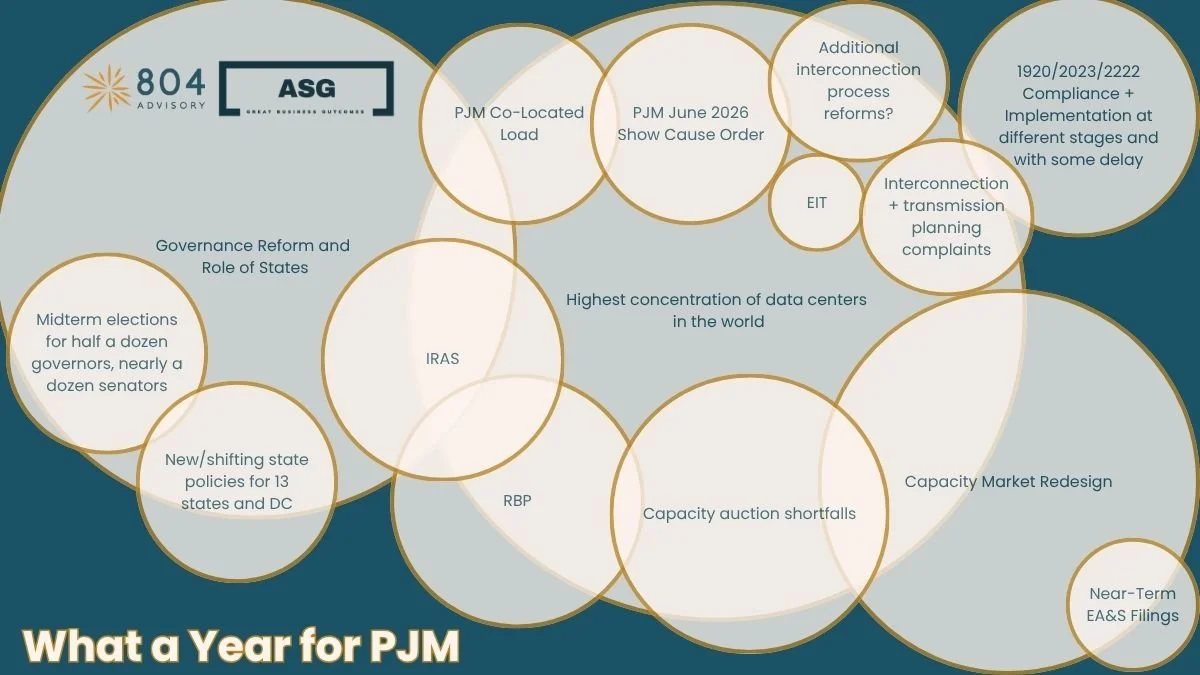
If you’re a PJM stakeholder, you’ve probably had a busy 2026. It’s hard to know where to start, right? I sat down to map out what was happening in the region and scribbled out what eventually became the above diagram.
Clearly, this moment for PJM is not just intense and high stakes. It is possibly transformational. PJM’s Dominion zone, which “currently serves the largest concentration of data centers in the world,” has led Federal Energy Regulatory Commission (FERC), states, and others to the collective view that things need to change—and quick.
PJM took note. Since late last year, the grid operator has made an extraordinary number of policy proposals and much of it was in a short stretch between June and August 2026. The press headlines captured the larger themes—like political pressure from governors and the Reliability Backstop Procurement (RBP) proposal—but missed some of the important details of how these pieces relate to each other.
Here are five interesting developments that I think flew under the radar.
1. A large load’s place in the curtailment queue could become a monetizable product.
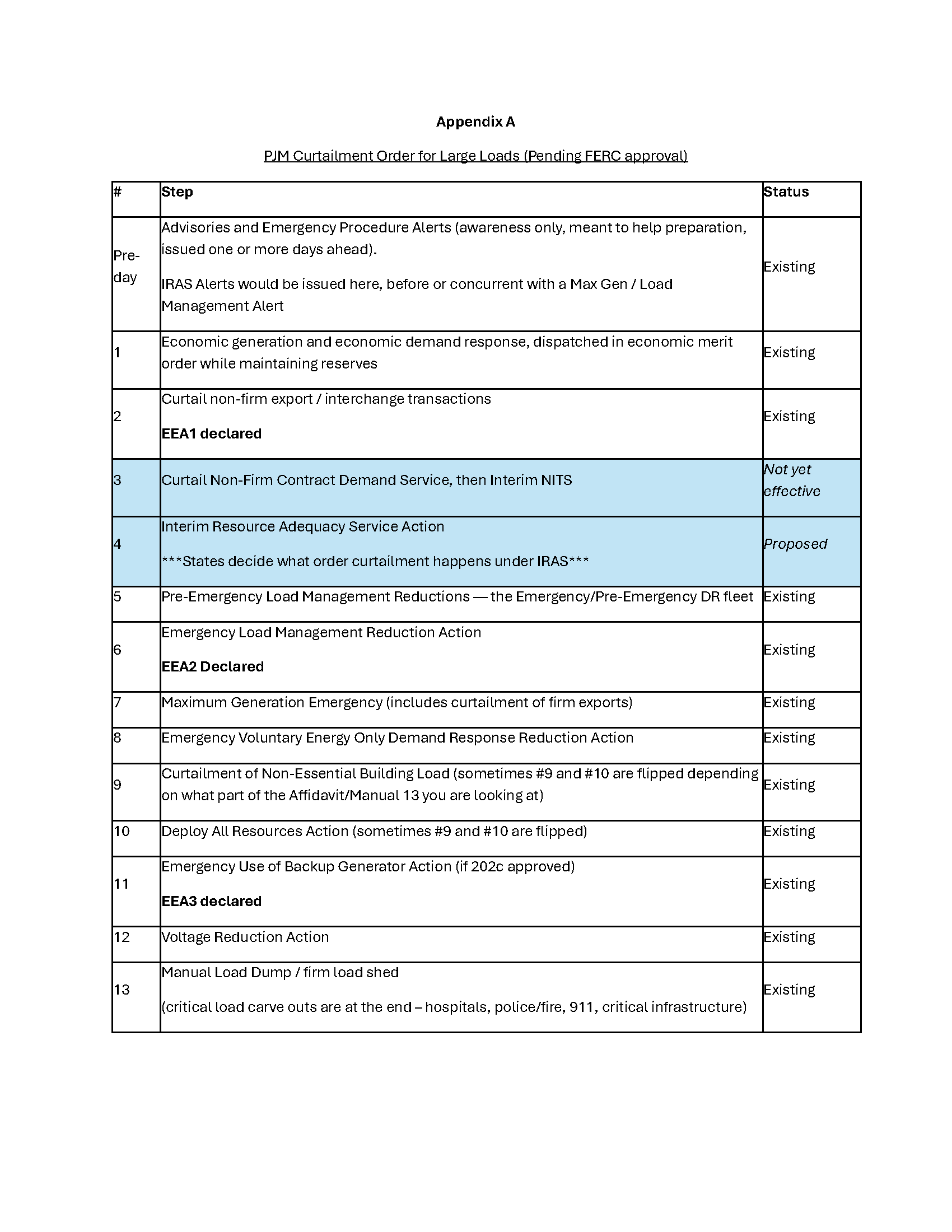
At a high level, PJM’s proposed Interim Resource Adequacy Service (IRAS) would preferentially curtail a large load that has not brought new capacity—but the business decisions are made at a much granular level. “Where do I exactly fall in the curtailment order” is now a question that large loads are trying to risk manage.
PJM has an “order of operations” for emergencies, and for a long time, nobody outside of operations really needed to know all the details. Now, PJM has proposed to insert two new rungs into the middle of the curtailment ladder: non-firm transmission services and IRAS (see Appendix A for the sequence).
Importantly, states will get to decide which large loads curtail first under IRAS, and that decision will be different for each state. Some states, like New Jersey and Pennsylvania, have issued laws or executive orders to influence this order such that certain loads (e.g., ones that offset demand) are curtailed later than other large loads.
Why does that matter? In short, the answer to the question, “will I be curtailed under IRAS” is not a clear “yes” or “no.” It involves assessing who will be curtailed ahead of you (e.g., how many large loads will take non-firm transmission service) and what states will decide about the IRAS curtailment order, neither of which is knowable right now. Practically, it means that data centers seeking curtailment protection will need to assess whether contracting with new generation will sufficiently decrease the risk of curtailment without guaranteeing it (because PJM cannot make the ultimate curtailment decision; only states can). Will large loads be willing to pay for new capacity given the uncertainty of that protection?
2. The “dance” between PJM and its states on implementation is running into timeline challenges.
For RBP and IRAS, cost allocation and curtailment order will be largely determined by the states. For example, PJM allocates RBP costs to its zones, but then the states are the ones who decide how to suballocate costs to retail customers. The same division governs the IRAS proposal—PJM directs a zone to curtail by a certain amount, and states and their electric distributors then determine which customers will curtail.
This all requires states and their commissions to act very quickly, and most PJM states have not yet opened a docket (apart from Pennsylvania which has started the process). Generally, PJM’s deadlines are coming up fast: the RBP window could close in October, and the IRAS implementation date could start June 2027. States have a short period to make critical decisions, and some will need to accelerate processes they were expecting to take a year or more. As a result, commercial arrangements are navigating uncertainty about (1) whether and how RBP/IRAS get through FERC, (2) whether and how states will implement their portion of RBP/IRAS, and (3) whether and how it all gets done in time for the music to start.
3. Strangely, a data center can set its own wholesale rate to zero for IRAS compensation.
This one is a bit odd. PJM proposes a maximum rate for IRAS curtailment, meaning that large loads that curtail under IRAS may be paid to curtail. But PJM also appears to allow an eligible large load to choose to reduce its own compensation or waive it entirely. Some large loads may keep the compensation, some may choose to reduce what they earn, and others may opt for no compensation.
In other words, this could be a Commission-jurisdictional rate that could vary customer by customer, based on a large load’s own choice. Of course, PJM built this option into its proposal so that loads that made the Ratepayer Protection Pledge could keep that pledge. But a FERC jurisdictional rate that could vary for similarly situated customers is not a construct I have seen before. The Commission is generally less concerned about rate reductions than rate increases, so that might be the legal hook for approval. In any case, if this proposal passes, I’d probably expect litigation from consumer advocates and organizations about whether the large loads can be compensated at all for IRAS.
4. Removing large loads from the VRR curve could be one of the most impactful policies.
Adjusting the Variable Resource Requirement (VRR) curve is one of the more impactful policy changes PJM is proposing because it could have cost-reducing impacts many years down the road. Let me explain.
Starting with the 2029/2030 Delivery Year (for which the BRA will take place in December 2026), new large load that has not procured its own new capacity gets excluded from the demand curve PJM uses to procure capacity. This is unusual - PJM is basically saying that it will not plan its system for a large load that does not bring its own new capacity. Practically, this means existing customers stop paying higher prices to buy capacity due to loads that brought no new capacity. And it means that the load is subject to a higher risk of curtailment each year that it fails to bring new capacity (and in some cases, faced with that choice, some large loads may seek to fully island from the system or locate outside of PJM).
This one is a little bit deep in the weeds, but the impact could be high. Joint Consumer Advocates called it “the most beneficial ratepayer aspect of IRAS as currently proposed” and public interest organizations called it “the lynchpin of the IRAS filing.” Not surprisingly, there is strong opposition from generators and data centers, with at least one party arguing that it “seeks to erase load from the demand curve notwithstanding that the load actually exists.” But that appears to be the point: by treating the load as if it doesn’t exist, PJM doesn’t plan to buy capacity for it.
5. New interconnection and joint study procedures could be on the horizon for PJM.
This one really flew under the radar. At a mid-August Co-Located Load Order Workshop, PJM floated a conceptual framework to integrate “generation interconnection, merchant transmission interconnection, long-term firm requests, and new Large Loads” and study them “cohesively” to determine the most efficient solution for a cluster. In the process, PJM hopes to reduce the New Service Request process to 12 months. In PJM land, that’s fast.
Since then, PJM has posted a few stakeholder PowerPoints to show how the new process would work in intricate detail:
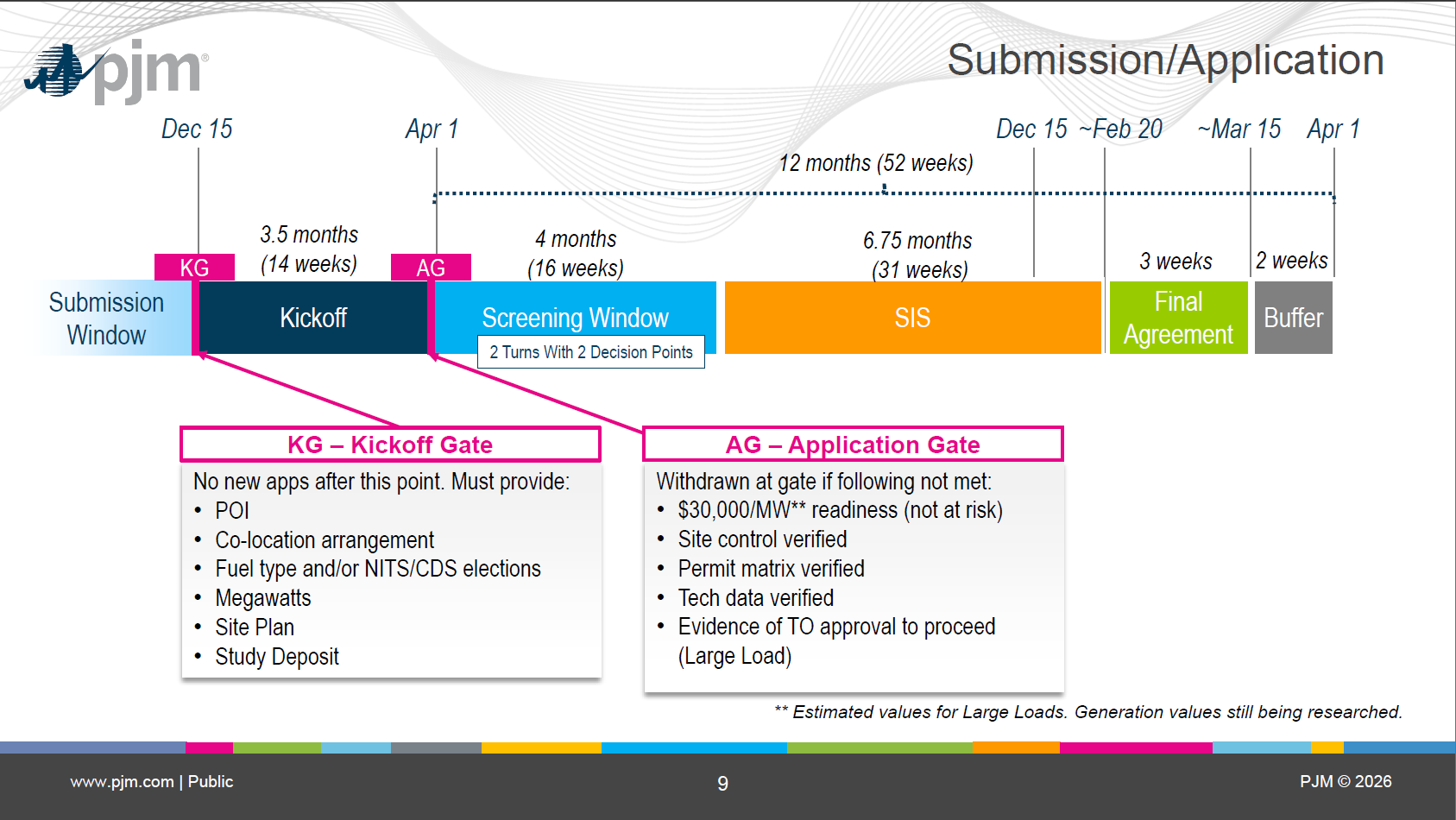
PJM, Show Cause for Large Loads Framework (Sept. 30, 2026)
This is not quite an SPP Consolidated Planning Process-style combination of transmission and interconnection planning, but it feels like a step towards better integration and holistic planning. To me, it signals that PJM recognizes that studying transmission, generation interconnection, and load interconnection in different silos is not necessarily the most efficient way to look holistically at the system’s needs. This one is worth watching as the details become clearer.
Also, the most recent presentation shows a new network service product called “Fractional Network Integration Transmission Service” (F-NITS). We don’t know much about it yet but color me intrigued.
***
So much has happened over the past few months, and the year is far from over. As we look at the weeks ahead, here are some questions that are top of mind:
Will FERC take PJM up on its NRG Power Marketing v. FERC consent argument to modify or sever any element of the RBP or IRAS proposals? And if so, can all the elements hang together in a way that gives the market confidence in the next six months?
Has anyone thought through how the co-located services will interact with Bring Your Own New Capacity (BYONC)? There are tensions between the Co-Located Load proceeding and the IRAS/BYONC proceeding such that co-location and BYONC are better seen as substitutes than complements.
On capacity market reforms, given all the voices interested in Path C, what is PJM’s appetite for a long-term transition to a market focused more on energy than capacity?
How much of the more novel structures of the RBP (like the peak shaving opt out) will carry over to annual auctions as a common business model? Will this build momentum for demand-side opportunities?
We’ll be watching these developments for ASG and their clients. If these topics impact you, send us a note at mary@804advisory.com or reach the ASG team at asg-team.com/contact-us.
Mary Yang is the COO and senior energy advisor at 804 Advisory. 804 Advisory operates at the intersection of energy policy, markets, and investment. The firm supports clients across the power sector, including investors, developers, and other stakeholders navigating regulatory and market complexity. For more information, visit www.804Advisory.com.