Texas and the Data Center Surge: Reforms, Flexibility, and Open Questions
As a Texan, I always cringed a little at the phrase “everything’s bigger in Texas.” But now that the Electric Reliability Council of Texas (ERCOT) is possibly facing 445 GW of large load applications by 2033, it actually seems apt. In the face of that challenge, Texas’s legislature, ERCOT, and the Public Utility Commission of Texas (PUCT) have moved quickly, while offering flexibility options for large loads that will be closely watched in other regions. And, in a sign that community concerns about data centers have made their way to the highest levels of government, on June 10, Texas Governor Greg Abbott (1) directed the PUCT and ERCOT to take further actions to protect ratepayers on June 10 and (2) set a legislative agenda to lower costs, require water-efficient technologies, and “reduce impacts on local communities.”
But before we begin, how applicable is Texas’s story to other parts of the country? In my role at 804 Advisory, I frequently hear how Texas’s successes are being considered as a model in other regions (e.g., connect and manage, ride-through requirements). Certain parts of the Texas model are unique: it is a single-state grid with one regulator and one grid operator; the legislature has been particularly active in the energy space following Winter Storm Uri; and, its regulatory structure is built on a unique framework (e.g., no capacity market, historical transmission planning successes through CREZ). But the challenges faced in Texas are similar to what we’re seeing around the country: not enough infrastructure being built to keep up with demand, load forecast difficulties that make it hard to plan, and the intensely political focus on what data centers mean for residents. This means that a significant portion of Texas’s reforms, especially the pieces relating to forward system planning and offering options for flexibility, could prove to be valuable lessons for other regions.
The story starts with SB 6—Texas’s multi-part legislative answer to the large load challenge. At a high level, it directs the PUCT to establish interconnection standards for loads of 75 MW or more, makes sure those loads pay their share of the interconnecting utility's costs, and creates mandatory and voluntary curtailment regimes for large loads. It also requires PUCT pre-approval before a large load can co-locate with, and net against, an existing generator.
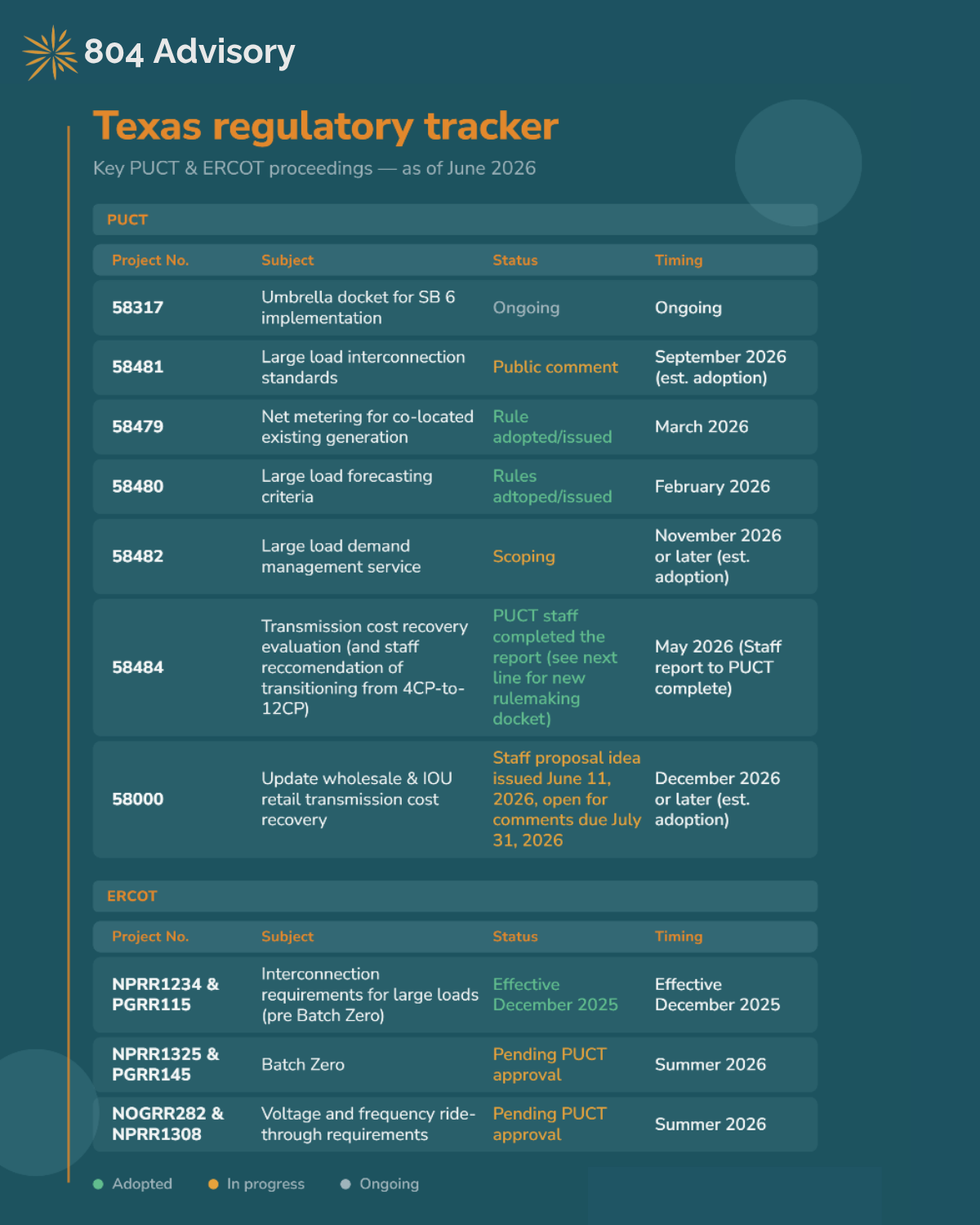
Since 2025 when SB 6 was signed, the PUCT has opened more than half a dozen dockets to evaluate various aspects of the law. Two rules have been finalized, involving net metering arrangements and large load forecast criteria, and several more are in active development, with target completion dates in late 2026 (e.g., large load interconnection, transmission cost allocation, demand management service).
But that’s not all. ERCOT has the ability to take some actions through revisions to its planning guides and protocols (subject to PUCT approval). Its Board recently endorsed new rules to (1) conduct a one-time backlog clearing study to allocate transmission capacity for mature large load projects (Batch Zero), and (2) institute ride-through requirements to ensure large loads do not trip offline and cause cascading outages. If approved by the PUCT, Texas will have moved far ahead of other states and regions in addressing and integrating its large load queue.
So what are the takeaways from all this activity?
1. Texas is moving really fast – even by its own standards. When I asked why agency large load rulemakings have moved so quickly, I was told “[t]hat’s what we expect here.” Yes, only one state is involved and the legislature’s directive has been a good source of motivation. But the PUCT has finalized multiple new rules in the past few months on large load issues, with a staff of ~280 people (i.e., a fraction of the size of FERC’s roughly 1,500-person staff). ERCOT has also been working to establish new market rules at breakneck speed.
2. Speed comes at a cost. I heard more than once that the intense focus on large loads in ERCOT has pushed other items to the back burner. Resource adequacy is the clearest example. Texas has been overdue for changes to its market design to ensure enough generation gets built. The PUCT’s first triennial review of its reliability standard is underway, but a key input (ERCOT's load forecast) is now waiting on the Batch Zero process before it can be finalized. Likewise, the Texas Energy Fund, the state's multi-billion dollar program to finance new gas generation, is also still ramping up. None of this is a criticism as much as an observation about resource scarcity and priorities. Right now, large loads are the overriding focus.
3. Texas’s Batch Zero process is a paradigm shift. The move to cluster studies is the main story here. Loads have historically been studied in Texas on a serial, first-come, first-served basis by the interconnecting utility. However, the volume and magnitude of data center interconnection requests had led to significant backlogs and restudies, similar in some respects to the long generator interconnection queues that have been heavily discussed at FERC in recent years.
Batch Zero is intended to clear the decks in one study. Large load projects join Batch Zero if their project is sufficiently mature and they have posted financial security of $50,000/MW. Following ERCOT’s study, projects will then be allocated what limited transmission capacity is available in the coming years. Data centers that are close to energization are already modeled as part of “base load” and will not have to go through the allocation process.
4. Flexibility is a key issue to watch in future ERCOT and PUCT actions. If a data center misses the Batch Zero boat, it may need to wait until the early 2030s to get transmission service. As a result, later-to-the-game hyperscalers are now more interested in “islanded” systems—co-located load, microgrids, or other alternative “bridge” options while they wait for full grid service.
In Texas, that isn’t new. Built through ERCOT protocols and PUCT case law since 2010, Texas has already had the concept of a “private use network,” or a PUN. The ERCOT Board endorsed a formalized approach to PUNs in early June called a “Withdrawal Limited Private Use Network” or WLPUN, which allows data centers to use a co-located generator as long as they comply with certain withdrawal limits. Many questions remain unsettled, however. For example, what happens to the generation asset when the large load finally receives full grid power? Can the generator be used as backup power, and under what conditions would that generator be controllable by ERCOT, if at all?
Similarly, the ERCOT Board endorsed a new concept called the “Provisional Controllable Load Resource,” or PCLR, which is a demand-response-like product that allows data centers to obtain more MWs in the near-term in exchange for curtailment when directed by ERCOT.
These two flexibility options aren’t the only ones that will materialize. SB 6 also requires the PUCT to establish a voluntary demand product under which curtailment can be competitively procured—another way developers can monetize flexibility, raising the question of who captures that value.
5. The Texas legislature is not done with large loads yet. Several ideas have been teed up for further legislation by Governor Abbott: more ratepayer protection mechanisms, revisiting the sales and use tax, water use considerations, and reducing noise and other impacts on local communities. The legislature meets once every two years, and momentum is building for the next round in January 2027 – fueled in part by local opposition to data centers that has been growing in Texas too. Hill County passed a yearlong moratorium against data centers (but withdrew it recently for legal reasons), and Hood County commissioners have considered a moratorium but declined to adopt one.
Despite these developments, many, many more questions remain for SB 6 implementation. I’ll leave you with a few of mine:
The PUCT seems poised to move away from a 4CP transmission cost allocation design. The final decision will significantly impact ratepayers, large loads of all kinds, and other customer groups depending on their ability to consistently flex during peak demand. What balance will the PUCT strike between hyperscalers and residential customers?
What additional rules will ERCOT propose for PCLR, WLPUN, and future Batches? Once Batch Zero rules are complete, ERCOT will turn to “Batch One” or “Batch N” rules.
How will the PUCT integrate its large load interconnection standards with ERCOT’s Batch Zero proposal? The PUCT has already pushed its own large load interconnection rule timeline back to accommodate an accelerated ERCOT batch study proposal.
What rules will be proposed and finalized around both mandatory and voluntary load shed, consistent with SB 6? The details of these rules represent potential revenue losses or revenue streams for large loads.
The PUCT and ERCOT rules were written quickly, so I expect interpretation and implementation gaps to arise. Will those gaps significantly impact the value of the new rules? Already, we are seeing gaps being identified by industry, like the question of whether the site control gating requirements include affiliates.
What will revised demand forecasts show, and what will it mean for the PUCT’s triennial assessment and transmission expansion plans? ERCOT’s preliminary forecast estimated 368 GW of total demand by 2032, when its all-time peak has been 85.5 GW. ERCOT and stakeholders are in the process of considering revised forecast methodologies in light of the batching process.
About Mary Yang
Mary Yang is the COO and senior energy advisor at 804 Advisory. 804 Advisory operates at the intersection of energy policy, markets, and investment. The firm supports clients across the power sector, including investors, developers, and other stakeholders navigating regulatory and market complexity. For more information, visit: www.804Advisory.com.